
Aletsch Glacier: Landscape as Sculpture
Updated: 2 hours ago
The eye follows the glacier through the landscape. Dark bands trace its curves, while layers of mountains rise behind it in the light. This expansive view is the starting point of our exploration: from the course of the ice stream to the fine structures of its surface.
After a winter with little snow and a hot summer, the glacier’s structures lay exposed. Dark bands, fine grooves and deep crevasses marked its surface. They drew our attention away from the wider landscape and towards the forms within the ice.

Dark bands in pale ice

The two dark bands are medial moraines made of rock debris. They form at Konkordiaplatz, where several ice streams meet: neighbouring lateral moraines merge and are carried downhill within the combined glacier. Their long curves trace the movement of the ice.
From the wider view to the detail

In a tightly framed view, the Aletsch Glacier takes on a different character. Blue ridges of ice extend across the image, separated by dark crevasses. Fine lines cover their surfaces. The eye follows a curve, wanders into a hollow and finds a similar form further back.
This photograph shows a small part of the glacier. It is precisely this limited field of view that reveals its structures. Without the sky or surrounding mountains, there is no clear sense of scale. Some forms recall weathered stone; others suggest folded fabric.
Closer to the ice

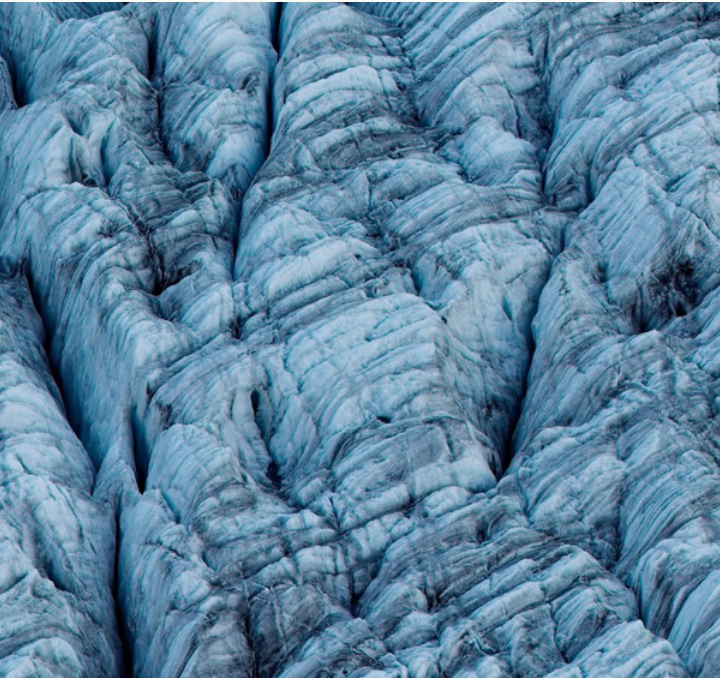
Colour holds the image together. The blue ranges from light, almost silvery surfaces to dark tones within the crevasses.
No ridge of ice is quite like the next. Together, however, they form a structure through which the eye can wander. From a distance, the photograph appears as a continuous relief. Up close, individual fractures and transitions emerge.
When it happens.